
This document examines the phenomenon of cloud bursts in Uttarakhand, with emphasis on causes, the role of deforestation, impacts on biodiversity, and historical data of major events over the past five years. It includes a detailed case study of the tragic 5 August 2025 Cloud Burst in Uttarakhand “Dharali, Uttarkashi”, and concludes with insights and recommendations. A FAQs section addresses common public concerns.
Table of Contents
- What is a Cloud Burst
- Causes of Cloud Bursts in Uttarakhand
Meteorological dynamics
Role of forest cutting for human use
- Impacts on Biodiversity
- Major Cloud Burst Events in Uttarakhand (Last 5 Years)
Data table
- Case Study: Uttarkashi Dharali Cloud Burst – 5 August 2025
- Summary
- Conclusion
- Frequently Asked Questions (15)
- References
1. What is a Cloud Burst
A cloud burst is an extreme, highly localized rainfall event—often more than 10 cm in under an hour—that dumps vast volumes of water over a small area, typically mountainous terrain . These sudden downpours can trigger flash floods and landslides with devastating speed.
2. Causes of Cloud Bursts in Uttarakhand
Meteorological Dynamics
In the Himalayas, moist monsoon air rises sharply due to hill area and than condenses rapidly. Mountains trap moisture-laden clouds, releasing intense rainfall in localized zones—especially over steep catchment areas like the Kheer Ganga basin .
Role of Forest Cutting for Human Use
- Deforestation for timber, infrastructure, and tourism infrastructure destabilizes soil moisture regimes.
- Removal of root systems reduces slope stability, making landslides more likely when heavy rain falls.
- Loss of tree cover reduces interception of rainfall, increasing the speed and volume of runoff reaching river channels.
3. Impacts on Biodiversity
- Rapid floods strip vegetation and soil, destroying micro-habitats.
- Aquatic species suffer sudden changes in river flow and sediment load.
- Forest fragmentation impedes wildlife corridors, reducing genetic diversity.
4. Major Cloud Burst Events in Uttarakhand (Last 5 Years)
| Year | Location | Date | Notable Impacts |
| 2021 | Chamoli | 14 Jun 2021 | Flash floods, major hydroelectric damage |
| 2022 | Pithoragarh | 20 Jul 2022 | Landslides, displaced families |
| 2023 | Chamoli-Simhura region | 3 Aug 2023 | Multiple deaths, infrastructure collapse |
| 2024 | Rudraprayag | 17 Jul 2024 | Tourism disruption, local floods |
| 2025 | Dharali (Uttarkashi) | 5 Aug 2025 | 4 dead, ~50 missing, >20 hotels washed away |
5. Cloud Burst Case Study: Dharali Uttarkashi Cloud Burst in Uttarakhand – 5 August 2025
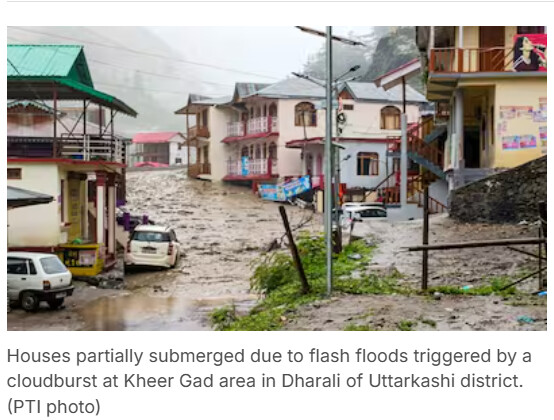
On 5 August 2025, a major cloud burst struck the catchment of Kheer Ganga near Dharali village, triggering sudden flash floods and debris slides that washed away homes, shops, and over 20–25 hotels and homestays . At least four persons were killed and around 50 reported missing or feared buried under debris . Rescue teams from the Indian Army, SDRF, NDRF and local authorities are working “on a war footing” to evacuate survivors and provide relief . Authorities had issued red alerts for heavy rainfall in Uttarkashi and adjacent districts starting August 4, supporting evacuations and school closures .
6. Summary
Cloud bursts are sudden, intense rainstorms that strike without warning, and in Uttarakhand, their impact is worsened by the region’s rugged terrain and growing human interference with nature—especially deforestation. These events often unleash devastating flash floods, trigger landslides, and severely harm the region’s rich biodiversity. The 5 August 2025 disaster in Dharali underscores the increasing human toll of climate extremes and unplanned development.
7. Conclusion
To mitigate future disasters, Uttarakhand must invest in reforestation, enforce land‑use planning, revamp early warning systems, and control construction in sensitive catchment zones. Restoration of native forests would help stabilize slopes, reduce runoff, and restore ecological resilience.
8. Frequently Asked Questions :Cloud Burst in Uttarakhand
- What triggers a cloud burst?
Rapid condensation of moist air over mountains causing extreme rainfall in short time.
- Why Uttarakhand is prone to them?
Mountainous terrain, monsoon moisture, and unstable geology.
- Can cloud bursts be predicted?
Currently very challenging; early warnings exist, but timing and location remain uncertain.
- Are global warming and cloud bursts linked?
Yes—climate change is increasing the frequency and intensity of extreme rainfall.
- Does deforestation increase risk?
Yes—loss of trees destabilizes slopes and increases runoff.
- Why is Dharali a hotspot?
Located in Kheer Ganga catchment with steep slopes and tourism infrastructure built on marginal terrain.
- Can building codes reduce risk?
Yes—regulating construction, avoiding riverbanks and unstable slopes helps.
Frequently Asked Questions :Cloud Burst in Uttarakhand
- How many people were affected in Dharali?
At least 4 confirmed dead and around 50 missing as of 5 Aug 2025.
- What was damaged most?
Over 20 hotels, shops, homes, and part of the market were washed away.
- Which agencies are involved in rescue?
Indian Army, SDRF, NDRF, fire, police, and district authorities.
- What about future rainfall forecasting?
India Meteorological Department issues alerts but cannot pinpoint cloudspots.
- How does biodiversity suffer?
Habitats destroyed, species displacement, river sedimentation, disrupted ecosystems.
- Is local tourism affected long-term?
Yes—damage to homestays and infrastructure harms livelihoods and discourages visitors.
- What role do locals play?
Community awareness, avoiding hazard zones, replanting, reporting early signs.
- How can deforestation be reversed?
Through state-led reforestation, supported local cooperatives, and community stewardship programs.
9. References
- AP News,
- The Indian Express,
- The Sun
- Telangana Today
- The Times of India,
- The Economic Times,
- Financial Express,
PRAKRITI DARSHAN-NATURE AND ENVIRONMENT MAGAZINE
Prakriti Darshan is a leading Hindi-language magazine and digital platform dedicated to raising public awareness on vital issues related to nature, biodiversity, climate change, sustainable development, and environmental conservation. This magazine represents a unique blend of science, society, and sensitivity—offering a common platform for researchers, students, NGOs, policymakers, nature lovers, and conscious citizens alike.
With thought-provoking articles, inspiring stories, environmental research, impactful projects, and policy perspectives, Prakriti Darshan is a transformative journey toward a greener and more sustainable future.
Let us come together to protect and preserve our planet for generations to come. 🌿🌍
Join us in our mission to protect and celebrate the planet. 🌏💚
Click for more information
- Visit www.prakritidarshan.com for Free Magazine ,Free membership benefits ,offered price magazine @ Rs.1 or Rs.11 only and more ……
- 🎗️Sponsor Prakriti Darshan Magazine – Support our environment mission.
- 📚 Explore the Environment Magazine – Read our latest and past issues.
- ✍️ Read Editor’s Article or Blog – Insightful thoughts from our editorial desk.
- 🌱 Join Membership – Be part of India’s leading green community.
- 🤝 Become an NGO Impact Story Partner – Share your grassroots impact nationwide.
- 🏢 Become a Company Partner – Showcase your CSR, ESG, or sustainability work.
- 👤 Become an Individual Partner – Volunteer, write, and raise your green voice.
- 📢 Advertise with Us – Reach eco-conscious readers across India.
- Eco Trails Newsletter
- Donate for “Hari Ho Vashundhara & Har school Hariyali “ Plantation campaign Associated Partner NGO :GDSS NGO www.gdssngo.org
BALA DATT SHARMA,
MANAGING EDITOR ,
PRAKRITI DARSHAN-NATURE AND ENVIRONMENT MAGAZINE