
The Wild Animal Protection Act, implemented through the Wildlife Protection Act, 1972, remains India’s most comprehensive conservation law. Over time, it has been strengthened with major amendments in 2002, 2006, 2013, and 2022, addressing global wildlife trade, habitat protection, enforcement mechanisms, and alignment with CITES (Convention on International Trade in Endangered Species of Wild Fauna and Flora).
The Act is now divided into 14 detailed chapters, each focusing on enforcement, conservation, trade regulation, plant protection, zoo management, tiger conservation, crime control, and property forfeiture. This article presents a fully updated and integrating clause-specific details as per FAOLEX (IND22711), UNEP legal repository, and national legislation references.
Aligned with the mission of Prakriti Darshan Magazine, the article highlights how legal reforms strengthen India’s wildlife conservation movement and support endangered species protection.
Table of Contents
- Introduction
- What the Wild Animal Protection Act Covers
- Full Chapter Structure of the Act
- Authorities and Appointments Under the Act
- Plant Protection: Section 17A to 17H
- Hunting, Capture & Prohibitions
- Sanctuaries, National Parks & Land Acquisition (Section 18 & Section 25)
- Central Zoo Authority & Captive Breeding
- National Tiger Conservation Authority
- Wildlife Crime Control Bureau
- Wildlife Trade & Commerce Regulations
- International Trade Under CITES (Chapter VB)
- Registration of Schedule IV Species (Section 49M)
- Licensing Rules for Breeders
- Overview of Amendments (2002, 2006, 2013, 2022)
- Importance for Endangered Species
- Role in Biodiversity & Sustainable Development
- Challenges & Enforcement Gaps
- Conclusion
- FAQs
- References
1. Introduction
India holds one of the world’s richest wildlife heritages. To safeguard this biodiversity, the Wild Animal Protection Act provides the legal backbone for controlling hunting, protecting habitats, preventing trafficking, and regulating international wildlife trade.
With extensive updates in 2002, 2006, 2013, and 2022, the Act now reflects modern conservation priorities, scientific management, and global environmental commitments.
2. What the Wild Animal Protection Act Covers
The Act governs:
- Wild animals, birds, reptiles, insects, and aquatic species
- Protected plants
- National Parks, Sanctuaries, Conservation/Community Reserves
- Wildlife trade (domestic & international)
- Zoo management & captive breeding
- Tiger conservation
- Wildlife crime control
- Property forfeiture from illegal wildlife dealings
3. Full Chapter Structure of the Act (Updated to 2022)
The Act contains 14 chapters, including major sub-chapters:
I. Preliminary
Definitions, scope, and terminology.
II. Authorities Under the Act
Director of Wildlife Preservation, Chief Wildlife Warden, Wildlife Wardens.
III. Hunting of Wild Animals
Complete prohibition except in special cases.
IIIA. Protection of Specified Plants
Regulates picking, uprooting, cultivating, and trade of protected plant species.
IV. Sanctuaries, National Parks & Closed Areas
Declaration of protected areas.
IVA. Central Zoo Authority & Zoo Recognition
Regulates zoos and captive breeding programs.
IVB. National Tiger Conservation Authority
Management of tiger reserves.
IVC. Wildlife Crime Control Bureau
Investigation of wildlife crimes & anti-trafficking operations.
V. Trade & Commerce in Wild Animals and Trophies
Regulation of animal articles and trophies.
VA. Prohibition of Trade
Trade of items from certain species is entirely banned.
VB. International Trade (CITES)
Import/export regulations for endangered species.
VI. Prevention and Detection of Offences
Arrests, search, seizure rules.
VIA. Forfeiture of Property
Confiscation of assets derived from illegal trade.
VII. Miscellaneous
General provisions and rule-making authority.
Structure of the Wild Life (Protection) Act – 14 Chapters
| Chapter | Title | Focus |
| I | Preliminary | Definitions & scope |
| II | Authorities | Appointments & powers |
| III | Hunting | Ban on hunting & exceptions |
| IIIA | Protection of Plants | Cultivation, trade rules |
| IV | Sanctuaries & National Parks | Protected area regulations |
| IVA | Central Zoo Authority | Zoo recognition & breeding |
| IVB | National Tiger Conservation Authority | Tiger conservation governance |
| IVC | Wildlife Crime Control Bureau | Crime prevention & intelligence |
| V | Wildlife Trade | Trade of animals & articles |
| VA | Prohibition of Trade | Total ban on Schedule I items |
| VB | CITES Compliance | International trade rules |
| VI | Offences | Penalties & enforcement |
| VIA | Forfeiture | Confiscation of illegal assets |
| VII | Miscellaneous | Legal procedures & powers |
Table : Species Examples in Schedules
| Schedule | Example Species |
| Schedule I | Tiger, Elephant, Snow Leopard, Great Indian Bustard |
| Schedule II | Nilgai, Blackbuck (with conditions) |
| Schedule III | Common Myna, Parakeets |
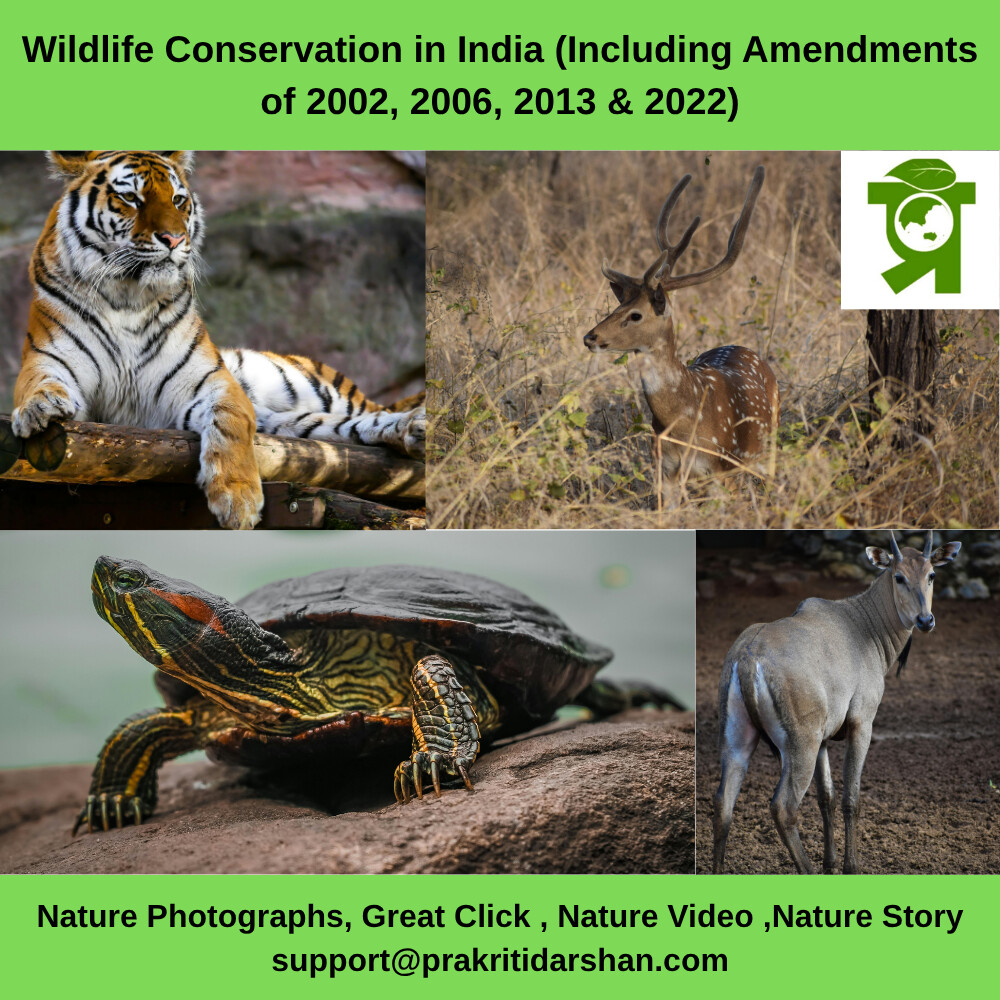
| Schedule IV | Exotic pets (turtles, macaws, iguanas) |
| Schedule V | Rats, crows (state-specific) |
4. Authorities and Appointments Under the Wild Life (Protection) Act – As per Amendment 2022 : Under Section 3 and 4
The Wild Life (Protection) Act, 1972, strengthened through multiple amendments—especially the Wild Life (Protection) Amendment Act, 2022 (No. 18 of 2022)—lays down a detailed structure of authorities responsible for wildlife conservation, enforcement, and ecological governance in India.
The 2022 amendment further enhances institutional capacity, strengthens CITES-related implementation, and increases the regulatory powers of central and state wildlife authorities.
Below are the updated statutory authorities and their roles:
4.1 Central Government Authorities (Under Section 3 – Updated 2022)
The Central Government is empowered to appoint key officials responsible for national wildlife administration and policy implementation.
4.1.1 Director of Wildlife Preservation (Mandatory Appointment)
- Acts as the topmost wildlife authority at the national level.
- Responsible for national-level enforcement of the Act.
- Supervises conservation programmes, CITES compliance, and protected area policies.
- Coordinates with state authorities, enforcement agencies, and international bodies.
4.1.2 Assistant Directors & Supporting Officers (New Strengthening Under 2022 Amendment)
The 2022 Amendment empowers the Centre to appoint:
- Additional Directors
- Assistant Directors
- Wildlife Inspectors
- Forest Officers and Technical Officers
These appointments ensure stronger enforcement and improved national oversight, especially regarding international trade regulation, wildlife crime prevention, and CITES Schedule management.
4.2 State Government Authorities (Under Section 4 – Updated 2022)
Each State Government plays a primary role in on-ground conservation.
The 2022 amendment emphasises accountability, reporting duties, and inter-state coordination.
4.2.1 Chief Wildlife Warden (CWLW)
- The highest wildlife authority within a state.
- Responsible for declaring and managing Sanctuaries, National Parks, Conservation Reserves, and Community Reserves.
- Issues (or denies) permits for hunting exceptions, research access, and plant collection under the Act.
- Oversees wildlife crime cases, seizures, rescue operations, and rehabilitation.
4.2.2 Wildlife Wardens / Assistant Wardens
- Assist the CWLW in enforcement and field-level supervision.
- Monitor wildlife habitats, movement patterns, offences, and local conservation measures.
- Implement community-based conservation and coordinate with district-level forest officers.
4.2.3 Honorary Wildlife Wardens (Strengthened under 2022 Amendment)
- Individuals from civil society appointed to support enforcement, awareness, and reporting of offences.
- The 2022 amendment gives states clearer guidelines for such appointments to promote public participation.
4. 3 Wildlife Advisory Board (Under Section 6 – Updated Responsibilities 2022)
Every State and Union Territory must constitute a State Wildlife Advisory Board.
The 2022 amendment gives the board broader ecological and CITES-aligned responsibilities.
Composition Includes:
- Minister in charge of forests or environment (Chairperson)
- Chief Wildlife Warden
- Ecologists, scientists, and conservation specialists
- NGO representatives
- Tribal welfare and social forestry experts
- Legislators and district representatives
Key Authorities Under the Wild Life (Protection) Act, 1972 & Amendment 2022
| Authority | Appointed By | Key Functions |
| Director of Wildlife Preservation | Central Government | National coordination, enforcement supervision, policy execution. |
| Additional Directors / Officers | Central Government | Assist in monitoring, enforcement, reporting. |
| Chief Wildlife Warden | State Government | Head of state-level wildlife protection system, permits, enforcement. |
| Wildlife Wardens | State Government | Field protection, anti-poaching, habitat monitoring. |
| State Wildlife Advisory Board | State Government | Policy advice, ecological planning, sanctuary declaration. |
Key Functions (Strengthened Under Amendment 2022):
- Policy Formation:
Advises the government on wildlife, habitat protection, and sustainable development. - Ecological Assessments:
Evaluates the ecological significance of areas before their declaration as National Parks, Sanctuaries, or Conservation Reserves. - Approval of Conservation Plans:
Reviews and approves state-level conservation and management plans for wildlife species, protected areas, and biodiversity corridors. - Monitoring Human–Wildlife Conflict Plans:
The 2022 amendment mandates guidance on conflict-mitigation strategies, rescue protocols, and compensation mechanisms. - CITES Implementation Guidance:
Under the new CITES Schedule introduced in 2022, the Board supports enforcement and awareness. - Community Participation:
Promotes community-based conservation and local stewardship of biodiversity.
4.4 Impact of 2022 Amendment on Wildlife Governance Structure
The 2022 Amendment is the most significant revision since 2006. It:
Introduces a new CITES Schedule, improving global trade compliance
Enhances powers of CWLW and Director of Wildlife Preservation
Strengthens the Wild Life Crime Control Bureau (WCCB)
Mandates stricter registration of Schedule IV species
Improves licensing requirements for breeders of Schedule species
Increases penalties for offences to deter illegal wildlife trade
These changes align India with global conservation commitments and strengthen both central and state mechanisms.
5. Plant Protection: Section 17A Onward
Sections 17A to 17H deal with Protection of Specified Plants:
- Picking, uprooting, or damaging protected plants is prohibited.
- Cultivation requires prior notification and approval.
- Trade and transport are regulated under licenses.
Plants protected under Schedule VI receive the highest level of legal protection.
6. Hunting, Capture & Prohibitions
Hunting is banned except in rare cases such as:
- Threat to human life
- Disease control
- Scientific research with approval
Violation leads to imprisonment and fines as per the amendments.
✅ Table: Penalty Comparison Before & After the 2022 Amendment
| Offence Type | Penalty Before Amendment | Penalty After 2022 Amendment |
| Hunting or attempting to hunt Schedule I species | 3–7 years imprisonment + minimum fine of ₹10,000 (which varied by state) | 3–7 years imprisonment + minimum fine ₹50,000, extendable to ₹5,00,000 |
| Repeat offences involving Schedule I species | Higher penalties existed but were inconsistently applied | Minimum fine ₹1,00,000, imprisonment up to 7 years mandatory |
| Hunting species in Schedule II or III | Fines often between ₹1,000–₹25,000 | Increased minimum fines ₹25,000–₹1,00,000 |
| Violation of sanctuary or national park rules | Penalties varied widely; fines were often low (₹500–₹5,000) | Updated fines ₹10,000+; repeat offences face additional imprisonment |
| Illegal trade or commerce in animal articles | Moderate fines, generally below ₹25,000 | Stricter fines ₹25,000–₹2,00,000 + possible imprisonment |
| Possession of unregistered trophies and animal articles | Mostly compoundable offences with small fines | Higher fines; articles/trophies seized + prosecution under stricter guidelines |
| Illegal international wildlife trade (CITES species) | Limited clarity; penalties varied | Clear, strong penalties under Chapter VB, imprisonment + heavy fines |
| Obstruction of a wildlife officer or failing to report offences | General penalties: small fines or short imprisonment | Specific penalties: higher fines + mandatory legal action |
| Captive breeding without license (exotic/CITES species) | Rarely enforced; minimal fines | Strict licensing rules + heavy penalties; specimen seizure |
| Destruction of habitat inside protected areas | Lesser penalties | Significantly enhanced fines + possibility of imprisonment |
7. Sanctuaries, National Parks & Land Acquisition (Section 18 + Section 25)
Section 18
States may declare any ecologically significant area a Sanctuary, even if outside forest reserves.
Section 25
Provides for acquisition of land rights to secure wildlife habitats.
8. Central Zoo Authority & Captive Breeding (IVA)
The Central Zoo Authority (CZA) oversees:
- Recognition and regulation of zoos
- Identification of endangered species for captive breeding
- Maintenance of genetic diversity
- Standards of animal care
This enhances scientific conservation efforts.
9. National Tiger Conservation Authority (IVB)
Established for:
- Managing tiger reserves
- Protocol for tiger conservation
- Reviewing protection strategies
- Monitoring tiger population trends
10. Wildlife Crime Control Bureau (IVC)
The bureau functions as India’s anti–wildlife trafficking body by:
- Investigating crime networks
- Coordinating interstate and international operations
- Assisting border agencies
- Maintaining national wildlife crime records
11. Wildlife Trade & Commerce Regulation (V & VA)
These chapters regulate:
- Sale of animal articles
- Possession of trophies
- Transport of wildlife materials
- Trade restrictions and licensing
Certain species have absolute trade bans.
12. International Trade Under CITES (Chapter VB)
India complies with CITES through this chapter.
Key features include:
- Appointment of Management Authority & Scientific Authority
- Import/export procedures for endangered species
- Ban on international trade of Schedule animals without approval
- Strong penalties for violations
13. Registration of Schedule IV Species (Section 49M)
Anyone possessing a live specimen of a Schedule IV species must:
- Report the details
- Register with the Management Authority
- Maintain documentation for future inspections
This combats illegal private possession.
14. Licensing Rules for Breeders
Breeders of certain scheduled species must obtain:
- License from Management Authority
- Regular monitoring
- Compliance with welfare standards
- Reporting of births and transfers
15. Overview of Amendments
Wildlife Protection Amendment Act, 2002 (Effective 20 Jan 2003)
- Strengthened penalties
- Revised schedules
- Improved enforcement powers
Amendment Act, 2006 (Effective 3 Sep 2006)
- Creation of NTCA
- Establishment of Tiger Reserves
- Stronger anti-poaching measures
Amendment Bill, 2013 (Passed 1 Jan 2013)
- Focus on better definitions & regulatory clarity
- Updated wildlife trade regulations
✅ Wildlife Protection Amendment Act, 2022 (Effective 19 Dec 2022)
- Alignment with CITES
- New species added to Schedules
- Stronger registration norms
- Enhanced penalties
Amendments to the Wild Life Protection Act
| Amendment Year | Key Provisions |
| 2002/2003 | Creation of Wildlife Crime Control Bureau (later formalized). |
| 2006 | Strengthened penalties; National Tiger Conservation Authority established. |
| 2013 | Compliance with CITES; plant protection. |
| 2022 | Rationalized Schedules; strict penalties; international trade compliance strengthened. |
16. Importance for Endangered Species
The updated Act protects species like:
- Tiger
- Elephant
- Asian Lion
- Rhino
- Red Panda
- Snow Leopard
- Gangetic Dolphin
17. Role in Biodiversity & Sustainability
The Wild Animal Protection Act plays a crucial role in strengthening India’s commitment to global sustainability goals. By protecting ecosystems, regulating wildlife trade, and ensuring scientific management of species, the Act directly contributes to three major Sustainable Development Goals (SDGs):
• SDG 15 – Life on Land
The Act safeguards terrestrial biodiversity through habitat protection, anti-poaching measures, regulated conservation programs, and the creation of sanctuaries and national parks. This ensures the survival of endangered species and maintains healthy forest ecosystems.
• SDG 13 – Climate Action
Healthy wildlife populations support resilient ecosystems that act as natural climate regulators. By conserving forests and wetlands, the Act enhances carbon sequestration and strengthens adaptation against climate-related events.
• SDG 14 – Life Below Water
Through CITES regulation and habitat protection, the Act helps prevent illegal exploitation of aquatic species and supports the conservation of freshwater and coastal biodiversity, contributing to sustainable use of marine resources.
18. Challenges & Enforcement Gaps
- Illegal trafficking networks
- Habitat encroachment
- Climate emergencies
- Human–wildlife conflict
Conclusion
The modern Wild Animal Protection Act combines scientific conservation, strong penalties, and international compliance under CITES. With updated amendments, empowered enforcement agencies, and comprehensive protection across 14 chapters, India’s wildlife law is stronger than ever.
Prakriti Darshan Magazine remains committed to spreading awareness, supporting conservation, and inspiring people to protect endangered animals and the environment. The journey toward saving our planet begins with informed action—and strong laws like this one.
Wild Animal Protection Act FAQs on CITES & Wildlife Trade Regulation (Chapter VB & Trade Rules) :
1. What is CITES and why is it important in India?
CITES (Convention on International Trade in Endangered Species) regulates global wildlife trade. India enforces CITES through Chapter VB of the Act to prevent species exploitation.
2. Does the 2022 Amendment strengthen CITES compliance?
Yes, it introduces clear definitions, new authorities, and stronger penalties for illegal international trade.
3. Who is the CITES Management Authority in India?
The Central Government designates the Management Authority, responsible for permits, monitoring, and compliance.
4. What is the role of the Scientific Authority?
It evaluates whether international trade will harm species survival and advises the Management Authority.
5. Can Schedule I species be traded internationally?
No. Schedule I (equivalent to CITES Appendix I) species have an absolute trade ban.
6. Do exotic pets fall under CITES rules?
Yes. Many exotic animals like macaws, iguanas, and boas fall under CITES Appendices and require proper registration.
7. What happens if someone owns a CITES species without registration?
They must register under Section 49M, or risk seizure and penalties.
8. Is import of exotic birds allowed?
Only with valid CITES permits and government clearance.
9. What documents are needed to trade a CITES species?
A valid import/export permit, origin certificate, and proof of legal acquisition.
10. Are Indian reptile species included in CITES?
Yes. Many, including Indian star tortoise, monitor lizards, and pythons.
FAQs on CITES & Wildlife Trade Regulation (Chapter VB & Trade Rules) :
11. Can wildlife articles made before 1972 be sold?
Only after proper registration and verification, and even then most cannot be traded.
12. What is prohibited under Chapter VA?
Trading trophies, skins, bones, horns, or any derivative of Schedule I species.
13. Is captive breeding of CITES species allowed?
Yes, but only with breeder licensing and reporting obligations.
14. Do tourists require permissions for wildlife souvenirs?
Yes. Many animal products are illegal to buy or carry internationally.
15. Is online wildlife trade banned?
Yes. Unauthorized digital trade of wildlife or exotic species is completely illegal.
16. How does India monitor cross-border wildlife trafficking?
Through WCCB, Customs, Forest Departments, and CITES authorities.
17. Are plants also included under CITES?
Yes. Certain orchids, succulents, and rare medicinal plants.
18. Can confiscated CITES animals be returned to owners?
Usually no; they are kept in rescue centers or repatriated.
19. What is the penalty for illegal international wildlife trade?
3–7 years imprisonment + heavy fines above ₹2 lakh.
20. How does CITES support Prakriti Darshan’s mission?
By protecting endangered species and curbing trade, it directly contributes to global biodiversity conservation.
Wild Animal Protection Act FAQs on Protected Areas: Sanctuaries, National Parks, Reserves
1. What is a Wildlife Sanctuary?
An area notified for wildlife protection where limited regulated human activity is allowed.
2. What is a National Park?
A stricter protected area where no human activity, grazing, or resource use is allowed.
3. What is the difference between Sanctuary and National Park?
Sanctuaries allow limited human use; National Parks do not.
4. What is a Conservation Reserve?
Buffer areas connecting habitats, managed jointly by government and local communities.
5. What is a Community Reserve?
Areas voluntarily conserved by local communities with government recognition.
6. What is a Closed Area?
Temporary protection zones where wildlife activities are restricted for specific periods.
7. Who declares a Sanctuary?
State Government under Section 18 of the Act.
8. What is the process to declare a National Park?
A legal notification, settlement of rights, land acquisition process, and ecological assessment.
9. Can people live inside a National Park?
Generally no; relocation is conducted with compensation.
10. Are rights of local communities protected in sanctuaries?
Yes. Rights are settled before final notification.
FAQs on Protected Areas: Sanctuaries, National Parks, Reserves
11. What activities are prohibited in Sanctuaries and National Parks?
Hunting, trade, grazing (in parks), logging, construction, and harmful activities.
12. Are safaris allowed inside National Parks?
Only regulated eco-tourism following strict guidelines.
13. Who manages a Sanctuary or National Park?
The Chief Wildlife Warden of the respective state.
14. Can protected areas be reduced or altered?
Only through government notification and after ecological assessment.
15. What is the role of Tiger Reserves?
They protect tiger landscapes, ecological corridors, and prey density.
16. What is the role of NTCA (National Tiger Conservation Authority)?
It sets standards for protection, monitoring, and management of tiger habitats.
17. Are all protected areas fenced?
No. Fencing is used selectively to maintain ecological connectivity.
18. What is eco-sensitive zone (ESZ)?
A regulated buffer zone around protected areas for reducing anthropogenic impacts.
19. Can industries operate near protected areas?
Only with strict environmental clearance.
20. How do protected areas support biodiversity?
They preserve ecosystems, provide safe habitats, and prevent species extinction.
Wild Animal Protection Act FAQs on the Wild Life (Protection) Amendment Act, 2022 :
1. What is the purpose of the 2022 Amendment Act?
To modernize wildlife protection laws, strengthen CITES compliance, and increase penalties.
2. How many schedules remain after the 2022 revision?
Schedules were rationalized to reduce overlaps and simplify classification.
3. What new changes were introduced in species schedules?
Better alignment with CITES Appendix categories.
4. Are penalties harsher after the 2022 Amendment?
Yes. Fines increased to ₹50,000–₹5,00,000 for major offences.
5. Does the amendment cover exotic species?
Yes. Ownership and breeding of exotic animals require mandatory registration.
6. Did the amendment introduce new authorities?
It strengthened roles of the Management Authority and Scientific Authority under CITES.
7. What changes were made in wildlife trade rules?
Clear rules for import/export, breeder licensing, and complete bans on Schedule I trade.
8. Does the amendment increase powers of enforcement officials?
Yes. Forest officers now have stronger powers to seize and act against violators.
9. What new rules apply to wildlife trophies?
All trophies must be registered under revised provisions.
10. What is Section 49M?
It requires reporting and registration of living CITES species (Schedule IV).
FAQs on the Wild Life (Protection) Amendment Act, 2022 :
11. Are private zoos impacted by the amendment?
Yes. Compliance with Central Zoo Authority norms is now stricter.
12. Does the amendment support global conservation goals?
Yes, especially SDG 15 (Life on Land) and SDG 13 (Climate Action).
13. How does the amendment address illegal wildlife trade?
With stronger penalties, better CITES alignment, and strict monitoring.
14. Does it affect indigenous communities?
Only in terms of regulated rights; recognized rights are respected.
15. Are rescue centers regulated under the amendment?
Yes. Rescue, rehabilitation, and transit facilities fall under stricter oversight.
16. How does the amendment strengthen tiger conservation?
By empowering NTCA and enhancing penalties for tiger-related crimes.
17. Does it help reduce exotic pet smuggling?
Yes. All exotic species must be legally declared and registered.
18. Does the amendment promote sustainable use?
Yes, by creating clear regulations for permitted trade and breeding.
19. How does the amendment support habitat conservation?
It strengthens rules against habitat destruction inside protected areas.
20. Why is the 2022 Amendment historically significant?
It is the most comprehensive update to wildlife law in India in 50 years.
References
- Government of India – Wildlife Protection Act, 1972
- National Biodiversity Authority Reports
- Wildlife Crime Control Bureau Documents
- WWF India – Conservation Programs
- Project Tiger and Project Elephant Data
- UNEP & UN SDG Knowledge Platform
Downloads :
IND22711https://faolex.fao.org/docs/pdf/IND227113.pdf3.pdf
Wild Life (Protection) Amendment Act, 2022 (No. 18 of 2022).
on 19 Dec 2022
Wild Life (Protection) Amendment Bill, 2013 (No. XXXI of 2013).
on 01 Jan 2013
Wildlife (Protection) Amendment Act, 2006 (No. 39 of 2006).
on 03 Sep 2006
Wild Life (Protection) Amendment Act, 2002, No. 16 of 2003.
on 20 Jan 2003
Global Appeal for Support: Prakriti Darshan – Nature and Environment Magazine & Journal
Dear Respected Leaders, Organizations, and Changemakers,
At a time when the world faces unprecedented challenges of climate change, biodiversity loss, deforestation, pollution, and global warming, collective action has become the need of the hour. The responsibility of protecting our planet cannot rest on a few shoulders—it must be a shared mission across governments, global institutions, businesses, academia, and communities.
About Us
Prakriti Darshan – Nature and Environment Magazine (www.prakritidarshan.com) and Prakriti Darshan :International Journal of Environment Science & Multidisciplinary Studies (www.prakritidarshanjournal.com) are global initiatives dedicated to:
- 🌱 Promoting environmental awareness and education.
- 🌎 Supporting United Nations Sustainable Development Goals (SDGs).
- 🦋 Highlighting the role of climate action, biodiversity conservation, renewable energy, eco-friendly practices, and sustainable living.
- 📚 Encouraging research and publications through our international journal.
- 🌳 Driving grassroots action through plantation, seminars, and workshops in schools, institutions, and communities.
Our Global Objectives
We aim to:
- Publish and distribute our environmental magazine free of cost worldwide to increase public awareness.
- Extend the magazine into multiple languages to reach diverse populations.
- Organize environmental seminars, conferences, and workshops both online and offline at schools, universities, and community levels.
- Build a platform for research, policy dialogue, and public participation in environmental conservation.
Our Humble Appeal
We invite Governments, UNEP, UNDP, UNESCO, FAO, IUCN, World Bank, international NGOs, corporates, green businesses, and philanthropists to come forward and strengthen this movement by:
✅ Sponsorship & Advertisements – Support us in reaching millions with environmental knowledge.
✅ Membership Programs – Join our network of eco-conscious individuals and organizations.
✅ Funding Support – Help us distribute Prakriti Darshan Magazine worldwide free of cost.
✅ Collaborations – Partner with us to host environmental events, campaigns, and research projects.
✅ Publishing with Us – Academics, researchers, and writers are invited to publish in our journal to spread innovative ideas globally.
Why Support Us?
By supporting Prakriti Darshan, you directly contribute to:
- SDG 4: Quality Education – spreading environmental education.
- SDG 13: Climate Action – mobilizing communities against climate change.
- SDG 15: Life on Land – promoting biodiversity conservation and plantation drives.
- SDG 17: Partnerships for the Goals – building a global movement through collaboration.
Together, We Can Create Change
Your support will help us expand our reach globally, develop multi-language editions, train young eco-leaders, and inspire millions to protect our only home—Planet Earth.
🌿 Let us join hands to create a world where environment and humanity coexist in harmony.
📩 Contact us through our portals:
- 🌐 www.prakritidarshan.com
- 🌐 www.prakritidarshanjournal.com
- WhatsApp :+91-8191903650 & +91-8191903651
- E mail : support@prakritidarshan.com & editor@prakritidarshanjournal.com
📢 Join the movement – Sponsor, Advertise, Become a Member, Publish, and Support Awareness Campaigns.
👉 Prakriti Darshan is not just a magazine—it is a voice for the planet. With your partnership, we can make it louder, stronger, and global.
Click for more information
- Visit www.prakritidarshan.com for Free Magazine ,Free membership benefits ,offered price magazine @ Rs.1 or Rs.11 only and more ……
Donate for “Hari Ho Vashundhara & Har school Hariyali “ Plantation campaign Associated Partner NGO :GDSS NGOwww.gdssngo.org
🎗️Sponsor Prakriti Darshan Magazine – Support our environment mission.
📚 Explore the Environment Magazine – Read our latest and past issues.
✍️ Read Editor’s Article or Blog – Insightful thoughts from our editorial desk.
🌱 Join Membership – Be part of India’s leading green community.
🤝 Become an NGO Impact Story Partner – Share your grassroots impact nationwide.
🏢 Become a Company Partner – Showcase your CSR, ESG, or sustainability work.
👤 Become an Individual Partner – Volunteer, write, and raise your green voice.
📢 Advertise with Us – Reach eco-conscious readers across India.
BALA DATT SHARMA,
MANAGING EDITOR ,
PRAKRITI DARSHAN-NATURE AND ENVIRONMENT MAGAZINE