
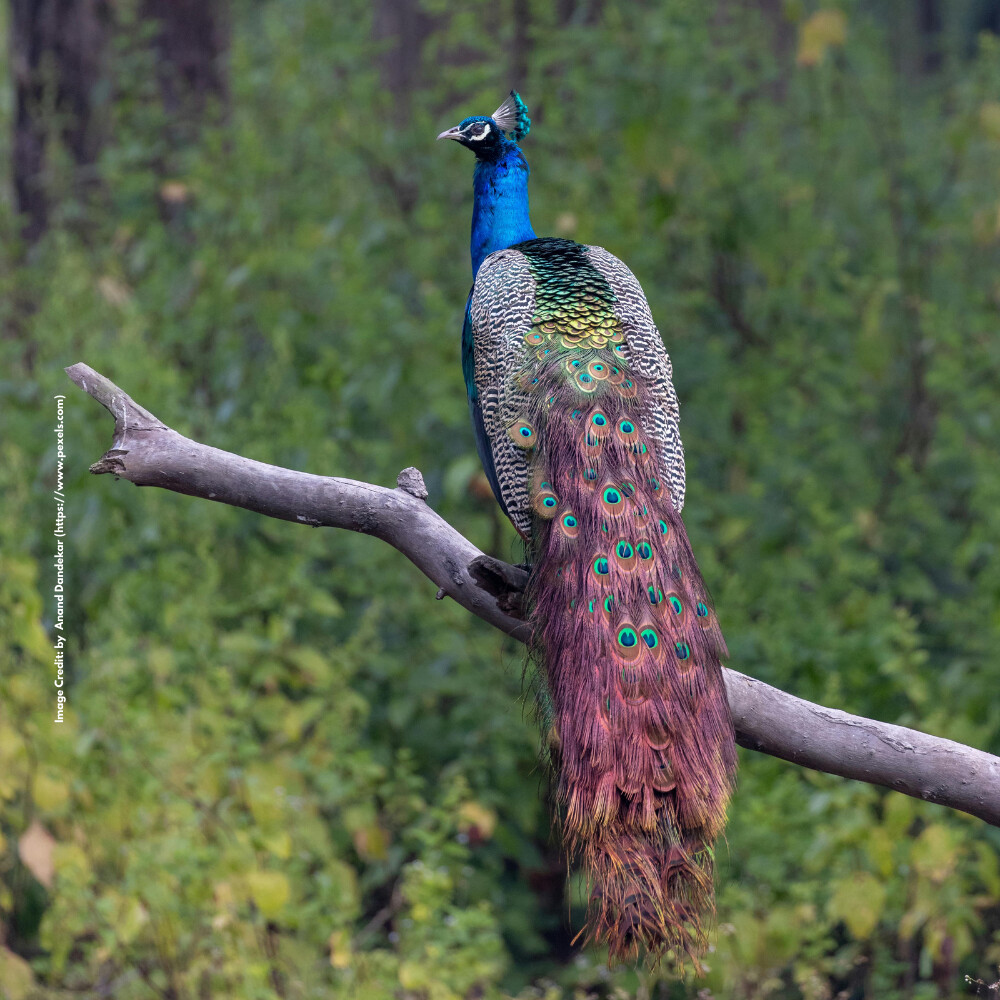
Peacock National Bird of India – A Symbol of Nature’s Pride and Cultural Heritage : The Peacock (Pavo cristatus), declared as the National Bird of India in 1963, is a magnificent creature that represents the nation’s beauty, culture, and biodiversity. Known for its iridescent feathers and majestic dance, the peacock is more than a symbol of elegance — it stands as a guardian of the ecological balance and an integral part of India’s heritage. This article explores the scientific, cultural, and environmental importance of the peacock, while emphasizing the need for conservation and awareness. Prakriti Darshan – Nature and Environment Magazine continues to advocate for the protection of birds like the peacock, highlighting their crucial role in preserving the balance of nature and the spirit of India.
Table of Contents
- Introduction
- Why Peacock is the National Bird of India
- Scientific Classification
- Physical Characteristics and Unique Features
- Behavior and Courtship Display
- Habitat and Distribution
- Diet and Ecological Importance
- Cultural and Mythological Significance
- Peacock and Environmental Symbolism
- Threats to Peacock Population
- Legal Protection under Indian Wildlife Laws
- Conservation Efforts and Government Initiatives
- Role of Communities, NGOs, and Media
- Peacock in Indian Art, Literature, and Festivals
- Global Recognition and Symbolism
- Interesting Facts about Peacocks
- Importance of Bird Conservation
- Prakriti Darshan’s Vision for Peacock Protection
- Frequently Asked Questions (FAQs)
- Conclusion
- References
1. Introduction
Among all the magnificent birds that inhabit India’s skies, none capture the heart and soul of the nation quite like the Indian Peacock (Pavo cristatus). Adorned with vibrant plumage, the peacock is not just an aesthetic marvel but a living emblem of India’s natural and cultural identity. Declared the national bird in 1963, it symbolizes grace, pride, spirituality, and biodiversity. This bird’s presence in mythology, folklore, and art reflects the deep bond between nature and Indian civilization.
Peacocks inhabit a wide range of environments—from forest edges and grasslands to farmlands and temple courtyards—making them one of the most visible and beloved birds across India. However, modern threats such as habitat destruction, hunting, and pesticide use have put this national treasure at risk, making conservation efforts more crucial than ever.
2. Why Peacock considered as a National Bird of India
The selection of the peacock as India’s National Bird was guided by multiple factors—its distinctive beauty, cultural significance, and ecological value. The peacock’s radiant feathers, proud posture, and graceful movements have long been associated with India’s diverse heritage. The bird’s prevalence across most states and its deep connection to Hindu mythology made it an ideal symbol to represent the unity and spirit of India.
Furthermore, the peacock reflects India’s environmental richness, signifying harmony between humans and nature. Its presence often indicates ecological stability and the health of natural surroundings.
3. Scientific Classification : Peacock National Bird
| Category | Details |
| Common Name | Indian Peacock |
| Scientific Name | Pavo cristatus |
| Kingdom | Animalia |
| Phylum | Chordata |
| Class | Aves |
| Order | Galliformes |
| Family | Phasianidae |
| Conservation Status (IUCN) | Least Concern |
| Habitat | Forest edges, agricultural lands, grasslands |
4. Physical Characteristics and Unique Features
The peacock is easily recognized by its iridescent blue and green feathers, crowned head, and long tail feathers, called the “train.” The male’s tail consists of over 100 elongated upper-tail coverts, each tipped with an eye-like pattern. These feathers can be spread in a fan during courtship displays to attract females.
The female peafowl, known as a peahen, is comparatively smaller and less colorful, featuring brown and grey tones to blend into surroundings while nesting. Despite their difference in appearance, both play vital roles in maintaining the species’ ecological balance.
5. Behavior and Courtship Display
Peacocks are best known for their spectacular mating dance. During the monsoon season, males spread their dazzling feathers, vibrating them rhythmically to attract females. The iridescence of their feathers, caused by microscopic structures that reflect light, enhances this dramatic display.
They are diurnal birds, meaning they are active during the day, feeding in open fields and resting in trees at night. Their loud, distinctive calls are often heard before rainfall, earning them the nickname “weather forecasters of nature.”
6. Habitat and Distribution
Native to the Indian subcontinent, peacocks are found throughout India, Sri Lanka, and parts of Myanmar. They thrive in dry and semi-dry regions, forests, and agricultural lands. States such as Rajasthan, Madhya Pradesh, Gujarat, and Tamil Nadu have large peacock populations.
Their ability to adapt allows them to live near human settlements and temples, symbolizing peaceful coexistence between people and wildlife.
7. Diet and Ecological Importance
Peacocks are omnivorous, consuming grains, seeds, fruits, insects, small reptiles, and snakes. This diet benefits farmers by naturally controlling pests and small vermin. Their feeding habits contribute to seed dispersal, aiding plant regeneration and maintaining ecological equilibrium.
8. Cultural and Mythological Significance :Peacock National Bird
The peacock’s presence in Indian mythology and culture is profound. In Hinduism, the peacock is associated with Lord Krishna, who adorns its feather on his crown, symbolizing beauty and compassion. It also represents Goddess Saraswati—the goddess of wisdom—and serves as the mount of Kartikeya, the god of war.
Peacocks appear in ancient literature, Mughal art, temple carvings, and classical dance costumes. The famous Peacock Throne of Emperor Shah Jahan remains one of the most iconic symbols of royal splendor in world history.
9. Peacock and Environmental Symbolism
Environmentally, the peacock is a bioindicator species—its presence often reflects a healthy ecosystem. A thriving peacock population indicates abundant vegetation, clean air, and sustainable water sources. Thus, conserving peacocks directly supports broader biodiversity goals aligned with the United Nations Sustainable Development Goals (SDGs 13, 14, and 15).
10. Threats to Peacock Population
Despite their protected status, peacocks face several challenges:
- Habitat loss due to urbanization and agriculture expansion
- Illegal hunting and trade of feathers
- Pesticide poisoning from contaminated food sources
- Climate change affecting breeding patterns
- Road accidents and human disturbances
11. Legal Protection under Indian Wildlife Laws
The Indian Peacock is protected under Schedule I of the Wildlife Protection Act, 1972, giving it the same level of protection as tigers and elephants. This makes hunting, capturing, or trading of peacocks and their feathers illegal and punishable by law.
12. Conservation Efforts and Government Initiatives
Several initiatives have been launched to protect peacocks:
- State-level breeding programs and sanctuaries (e.g., Rajasthan’s Mor Valley Project).
- Awareness campaigns in rural areas to discourage illegal hunting.
- Monitoring programs by the Wildlife Institute of India and BNHS.
- Community conservation programs involving local farmers and eco-volunteers.
13. Role of Communities, NGOs, and Media
Organizations like BNHS, WWF-India, and Prakriti Darshan promote education, rescue efforts, and habitat restoration. Media and environmental journalism also play a critical role in spreading awareness about bird conservation, ensuring the message reaches the grassroots level.
14. Peacock in Indian Art, Literature, and Festivals
From the Ajanta murals to modern art, the peacock remains a central figure in Indian creativity. In Bharatanatyam and Odissi, dancers mimic the peacock’s movements to express joy and devotion. Festivals such as Janmashtami and Kartik Purnima celebrate the bird as a messenger of prosperity.
15. Global Recognition and Symbolism
Beyond India, peacocks symbolize royalty, immortality, and renewal in many cultures, including Greek and Persian civilizations. Globally, it is admired as one of the most beautiful birds in existence, contributing to wildlife tourism and cultural diplomacy.
16. Interesting Facts about Peacocks
- Peacocks can run at speeds of 10–15 km/h.
- They shed their feathers annually after the monsoon.
- Peacocks can fly short distances, mainly to escape predators.
- Their feathers contain crystal-like microscopic structures that refract light, not pigment.
- Peahens choose mates based on the symmetry and brightness of tail feathers.
- A group of peacocks is called an ostentation or a party.
- Peacocks can sense approaching rain.
- They are known to live 15–20 years in the wild.
- Peacocks are extremely loyal to their habitat.
- Their calls vary from loud screams to softer mating sounds.
17. Importance of Bird Conservation
Birds play vital roles in ecosystems — from pollination and seed dispersal to insect control. Conserving peacocks ensures the health of related ecosystems. Bird conservation is not just about species survival; it safeguards air, water, and soil quality, forming the basis of life on Earth.
18. Prakriti Darshan’s Vision for Peacock National Bird Protection
Prakriti Darshan – Nature and Environment Magazine emphasizes the integration of traditional knowledge with modern conservation strategies. Through awareness campaigns, educational programs, and international collaborations, it encourages communities to act as protectors of nature.
Protecting the peacock is symbolic of respecting India’s biodiversity and the planet’s natural harmony.
19. Frequently Asked Questions (FAQs) :Peacock National Bird
- What is the national bird of India?
The Indian Peacock (Pavo cristatus). - When was the peacock declared India’s national bird?
In 1963. - Why was the peacock chosen as the national bird?
Because of its beauty, cultural value, and ecological significance. - Where are peacocks mostly found in India?
Rajasthan, Madhya Pradesh, Gujarat, and Tamil Nadu. - What is the scientific name of the Indian Peacock?
Pavo cristatus. - What do peacocks eat?
Insects, seeds, small reptiles, and fruits. - Can peacocks fly?
Yes, short distances. - Are peacocks endangered?
No, they are listed as Least Concern by IUCN but locally threatened. - What is the lifespan of a peacock?
Around 15–20 years. - Is killing a peacock illegal in India?
Yes, under Schedule I of the Wildlife Protection Act, 1972.
19A. Frequently Asked Questions (FAQs) : Peacock National Bird
- How do peacocks help farmers?
By eating pests and maintaining crop health. - What does the peacock symbolize?
Beauty, pride, wisdom, and spirituality. - Do peacocks migrate?
No, they are largely sedentary. - When do peacocks dance?
Mainly during the monsoon season. - What is the role of peahens?
They incubate eggs and raise the young. - Do peacocks lose their feathers every year?
Yes, after the breeding season. - What are the colors of a peacock’s feathers?
Blue, green, and golden hues due to light reflection. - What is a baby peacock called?
A peachick. - Are peacocks sacred in any religion?
Yes, especially in Hinduism and Buddhism. - How can we protect peacocks?
Avoid using pesticides, stop illegal feather trade, and plant native trees. - What does Prakriti Darshan promote about peacocks?
Conservation through awareness, education, and research.
20. Conclusion
The Peacock, India’s National Bird, stands as a radiant symbol of the nation’s identity, reflecting its diverse ecosystem, ancient traditions, and commitment to harmony. Its beauty inspires art, faith, and environmental consciousness alike.
Yet, as development expands and habitats shrink, the peacock’s survival depends on collective human responsibility. By protecting the peacock, we protect the essence of Indian nature.
Prakriti Darshan – Nature and Environment Magazine urges every reader, researcher, and student to take part in this mission — to nurture compassion, respect biodiversity, and preserve the timeless dance of the peacock across India’s landscapes.
21. References
- Government of India, Ministry of Environment, Forest and Climate Change.
- Wildlife Protection Act, 1972 (India).
- BirdLife International Data – Pavo cristatus.
- IUCN Red List (2025 Update).
- Bombay Natural History Society (BNHS) Publications.
- Prakriti Darshan – Nature and Environment Magazine Archives.
- Indian Council for Forestry Research and Education (ICFRE) Reports.
Global Appeal for Support: Prakriti Darshan – Nature and Environment Magazine & Journal
Dear Respected Leaders, Organizations, and Changemakers,
At a time when the world faces unprecedented challenges of climate change, biodiversity loss, deforestation, pollution, and global warming, collective action has become the need of the hour. The responsibility of protecting our planet cannot rest on a few shoulders—it must be a shared mission across governments, global institutions, businesses, academia, and communities.
About Us
Prakriti Darshan – Nature and Environment Magazine (www.prakritidarshan.com) and Prakriti Darshan :International Journal of Environment Science & Multidisciplinary Studies (www.prakritidarshanjournal.com) are global initiatives dedicated to:
- 🌱 Promoting environmental awareness and education.
- 🌎 Supporting United Nations Sustainable Development Goals (SDGs).
- 🦋 Highlighting the role of climate action, biodiversity conservation, renewable energy, eco-friendly practices, and sustainable living.
- 📚 Encouraging research and publications through our international journal.
- 🌳 Driving grassroots action through plantation, seminars, and workshops in schools, institutions, and communities.
Our Global Objectives
We aim to:
- Publish and distribute our environmental magazine free of cost worldwide to increase public awareness.
- Extend the magazine into multiple languages to reach diverse populations.
- Organize environmental seminars, conferences, and workshops both online and offline at schools, universities, and community levels.
- Build a platform for research, policy dialogue, and public participation in environmental conservation.
Our Humble Appeal
We invite Governments, UNEP, UNDP, UNESCO, FAO, IUCN, World Bank, international NGOs, corporates, green businesses, and philanthropists to come forward and strengthen this movement by:
✅ Sponsorship & Advertisements – Support us in reaching millions with environmental knowledge.
✅ Membership Programs – Join our network of eco-conscious individuals and organizations.
✅ Funding Support – Help us distribute Prakriti Darshan Magazine worldwide free of cost.
✅ Collaborations – Partner with us to host environmental events, campaigns, and research projects.
✅ Publishing with Us – Academics, researchers, and writers are invited to publish in our journal to spread innovative ideas globally.
Why Support Us?
By supporting Prakriti Darshan, you directly contribute to:
- SDG 4: Quality Education – spreading environmental education.
- SDG 13: Climate Action – mobilizing communities against climate change.
- SDG 15: Life on Land – promoting biodiversity conservation and plantation drives.
- SDG 17: Partnerships for the Goals – building a global movement through collaboration.
Together, We Can Create Change
Your support will help us expand our reach globally, develop multi-language editions, train young eco-leaders, and inspire millions to protect our only home—Planet Earth.
🌿 Let us join hands to create a world where environment and humanity coexist in harmony.
📩 Contact us through our portals:
- 🌐 www.prakritidarshan.com
- 🌐 www.prakritidarshanjournal.com
- WhatsApp :+91-8191903650 & +91-8191903651
- E mail : support@prakritidarshan.com & editor@prakritidarshanjournal.com
📢 Join the movement – Sponsor, Advertise, Become a Member, Publish, and Support Awareness Campaigns.
👉 Prakriti Darshan is not just a magazine—it is a voice for the planet. With your partnership, we can make it louder, stronger, and global.
Click for more information
- Visit www.prakritidarshan.com for Free Magazine ,Free membership benefits ,offered price magazine @ Rs.1 or Rs.11 only and more ……
Donate for “Hari Ho Vashundhara & Har school Hariyali “ Plantation campaign Associated Partner NGO :GDSS NGOwww.gdssngo.org
🎗️Sponsor Prakriti Darshan Magazine – Support our environment mission.
📚 Explore the Environment Magazine – Read our latest and past issues.
✍️ Read Editor’s Article or Blog – Insightful thoughts from our editorial desk.
🌱 Join Membership – Be part of India’s leading green community.
🤝 Become an NGO Impact Story Partner – Share your grassroots impact nationwide.
🏢 Become a Company Partner – Showcase your CSR, ESG, or sustainability work.
👤 Become an Individual Partner – Volunteer, write, and raise your green voice.
📢 Advertise with Us – Reach eco-conscious readers across India.
BALA DATT SHARMA,
MANAGING EDITOR ,
PRAKRITI DARSHAN-NATURE AND ENVIRONMENT MAGAZINE